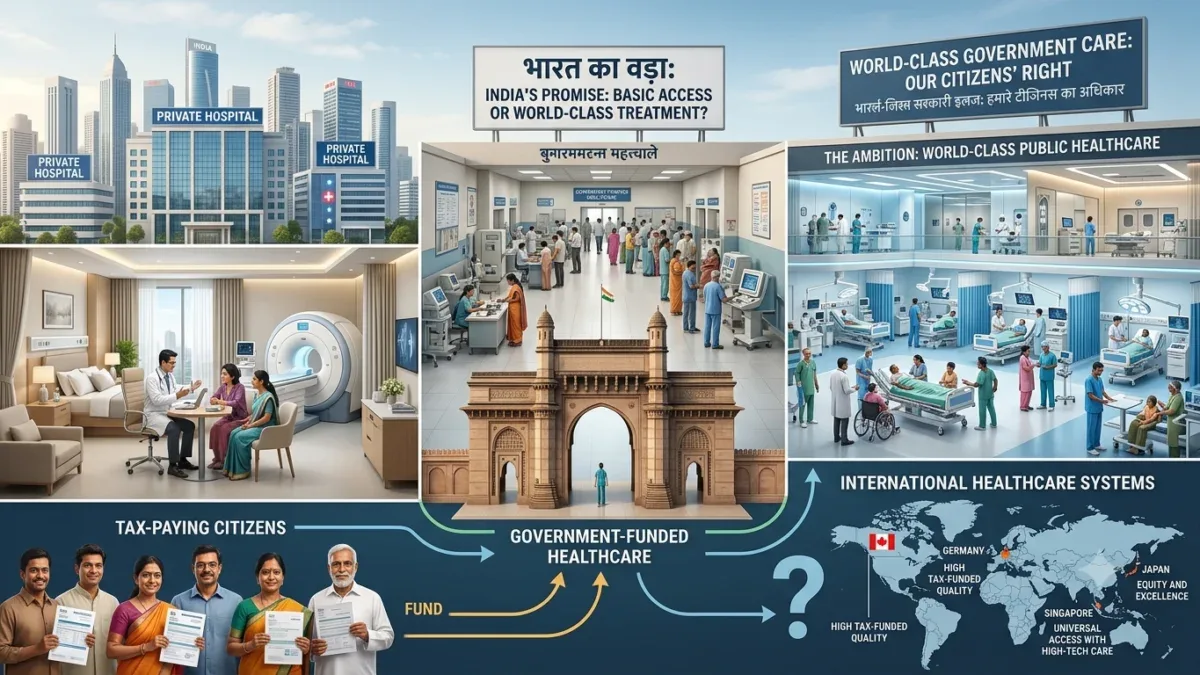
India mein private hospitals healthcare system ka visible aur powerful part ban chuke hain.
Major cities mein advanced private hospitals latest machines, specialist doctors, premium rooms aur specialised treatment offer karte hain.
Lekin isi ke parallel government hospitals ka question bhi important hai.
Agar private hospitals advanced healthcare provide kar sakte hain, to government-funded hospitals ko bhi world-class healthcare provide karne ki ambition kyun nahi honi chahiye?
Aur agar citizens taxes pay karte hain, to government ka healthcare promise sirf basic access tak limited hona chahiye ya high-quality treatment tak extend hona chahiye?
Is question ka answer India ke bahar ke healthcare systems ko dekhkar better understand kiya ja sakta hai.
No Country Has a Perfect Healthcare System
Sabse pehle ek important point.
United Kingdom, Canada, Australia ya koi bhi country perfect healthcare system nahi rakhti.
Har system ke challenges hain.
Waiting times ho sakte hain.
Funding pressure ho sakta hai.
Staff shortages ho sakte hain.
Private sector aur public sector ke relationships complex ho sakte hain.
Lekin different countries ke models se useful principles identify kiye ja sakte hain.
United Kingdom: Healthcare as a Public Service
United Kingdom ka NHS healthcare ko taxpayer-funded public service ke framework mein operate karta hai.
NHS England explicitly describes NHS services as free at the point of use for patients, while the system is taxpayer funded.
Iska philosophical foundation important hai.
Patient ko healthcare receive karne ke liye hospital gate par ability to pay prove nahi karni hoti for NHS-covered care.
Lekin NHS bhi pressure-free system nahi hai.
NHS England has discussed waiting-list pressures, productivity and the need for technological transformation.
India ke liye lesson:
Public healthcare free hone se automatically perfect nahi hota.
Strong management, technology, staff and funding equally important hain.
Canada: Public Funding With Private Delivery
Canada ka model India ke liye particularly interesting hai.
Canada ki government information ke according, provinces and territories publicly funded health insurance plans operate karte hain.
Medically necessary hospital and physician services insured hain.
Eligible residents ke liye these services patient charges ke bina publicly funded system ke through accessible honi chahiye.
Important point:
Canada private providers ko completely ban nahi karta.
Government information notes that many health services private providers ke through delivered hote hain, provided insured medically necessary services ke rules follow kiye jaate hain.
Yeh India ke liye powerful lesson hai:
Public financing aur private delivery ek saath exist kar sakte hain.
Australia: Public and Private Together
Australia ka healthcare system public and private components ko combine karta hai.
Australian Government ke according, Medicare-card holders public patients ke roop mein public hospitals mein eligible treatment free receive kar sakte hain.
Private hospitals bhi system ka important part hain.
Government information ke according, private hospitals private sector own and operate karta hai, while they are licensed and regulated by governments.
This is exactly the kind of balance India can study.
Private sector exists.
Public sector exists.
Government regulates.
Public financing protects access.
Private insurance provides additional options.
What Does This Mean for India?
India ko decide karna hoga ki private healthcare ko enemy samjha jaye ya partner.
A practical answer hai:
Neither.
Private healthcare ek provider hai.
Government healthcare public responsibility hai.
Regulator government hai.
Patient central stakeholder hai.
India Ki Current Reality
India ke National Health Accounts show karte hain ki government health expenditure ka share total health expenditure mein increase hua hai.
2022-23 estimates ke according government health expenditure 43.7% of total health expenditure tha, while out-of-pocket expenditure 43.4% tha.
Yeh numbers ek important contradiction show karte hain.
Government spending grow kar rahi hai.
But households still face substantial direct financial burden.
Therefore, next question should be:
How do we convert public spending into stronger public services and greater financial protection?
Public Hospital Should Be a Real Choice
India ke public hospital ko “free but inferior” category se bahar lana hoga.
A patient ko public hospital choose karne par yeh feel nahi hona chahiye ki:
“Paise bachane ke liye quality sacrifice kar raha hoon.”
Instead:
“I am choosing a high-quality public institution.”
This psychological change extremely important hai.
Government Hospitals Ko World-Class Banane Ka Formula
India ke public hospitals ke liye five priorities ho sakti hain:
Infrastructure
Modern buildings, ICUs, operating theatres and emergency departments.
Human Resources
Adequate doctors, nurses, technicians and support staff.
Technology
Advanced diagnostics, digital records and telemedicine.
Medicines
Reliable essential medicine supply.
Management
Professional hospital administration and measurable performance.
Public System Ko Waiting Time Se Measure Karein
Hospital quality ka ek measurable indicator waiting time hona chahiye.
Patients ko pata hona chahiye:
- emergency waiting time
- diagnostic waiting time
- surgery waiting time
- specialist appointment time
Public dashboards transparency improve kar sakte hain.
Private Hospitals Ko Transparent Banana
Government ko private hospitals ke liye also measurable transparency requirements create karni chahiye.
Patient ko treatment start karne se pehle estimated range provide ki ja sakti hai, except genuine emergencies.
Bills itemised hone chahiye.
Medicine pricing understandable honi chahiye.
Additional procedures ke liye consent process clear hona chahiye.
WHO Ka Global Perspective
WHO ke according private sector most health systems mein significant role play karta hai.
WHO ka focus private sector ko eliminate karne ke bajay effective governance ke through quality, equity, access and financial protection improve karne par hai.
This is important for India.
India ko public and private sectors ko ideological competition ke roop mein nahi dekhna chahiye.
System ko outcome ke basis par judge karna chahiye.
Taxpayer Ko Kya Milna Chahiye?
Taxpayer healthcare ke liye sirf hospital building nahi pay karta.
Public money should create:
Access
Quality
Safety
Availability
Affordability
Accountability
Agar public money spend hone ke baad citizen ko essential treatment ke liye private hospital jaana hi pade, to public system ki effectiveness ka question naturally arise hota hai.
Public Healthcare as National Security
Healthcare ko national security ke broader concept mein bhi dekhna chahiye.
Pandemic ne demonstrate kiya ki country ko strong public health infrastructure ki zarurat hoti hai.
Emergency mein private hospitals help kar sakte hain.
Lekin national-scale health emergency ko coordinate karne ke liye government capacity essential hoti hai.
India Ko Copy Nahi, Adapt Karna Chahiye
India UK ka exact NHS model copy nahi kar sakta.
Canada ka exact insurance model bhi copy nahi kar sakta.
Australia ka exact structure bhi replicate nahi kiya ja sakta.
But India principles adopt kar sakta hai:
Universal access
Public financing
Private participation
Strong regulation
Transparent pricing
High-quality public hospitals
The Real Competition
Future mein India ko public versus private debate ko quality competition mein convert karna chahiye.
Imagine a government hospital where:
- MRI reliable hai
- cancer specialist available hai
- surgery waiting time transparent hai
- medicines available hain
- hospital clean hai
- digital reports accessible hain
- patient complaints resolve hoti hain
Then private hospitals will still exist.
But patient choice becomes meaningful.
Supreme Court Debate Ka Global Context
Current Supreme Court scrutiny over medicine mark-ups provides an opportunity to ask broader questions about healthcare governance.
What should be regulated?
What should remain competitive?
What should government guarantee?
What should private hospitals disclose?
What should insurance cover?
What should public hospitals provide?
These questions should lead to long-term policy rather than temporary headlines.
Final Lesson
UK teaches the value of taxpayer-funded universal public service.
Canada demonstrates publicly funded medically necessary care with room for private providers.
Australia demonstrates that public and private hospitals can coexist under government regulation and public financing.
India can learn from all three.
But India also has a unique opportunity.
It can build a healthcare model designed for a huge population, digital public infrastructure, growing medical technology and diverse regional needs.
The target should not be:
Government hospital versus private hospital.
The target should be:
A healthcare system where every citizen can access excellent care.
If private hospitals deliver excellence, regulate them fairly.
If public hospitals deliver excellence, expand them.
If both sectors deliver quality, let citizens choose.
But no citizen should be forced into financial distress simply because the public alternative is weak.
That should be the real meaning of healthcare reform.
Frequently asked questions
Questions readers ask.
There is no universally perfect model. UK, Canada and Australia use different public-private arrangements, each with strengths and challenges.
India can study Canada’s publicly funded medically necessary hospital and physician services and its rules around access based on need.
Australia shows how public hospitals can provide free public-patient care while private hospitals operate alongside them under regulation.
The NHS demonstrates a taxpayer-funded healthcare model designed around care free at the point of use.
No. India should adapt useful principles to its own population, geography, financing capacity and healthcare needs.