Healthcare ka question sirf hospitals aur doctors ka question nahi hai.
It is a question about the relationship between citizen and state.
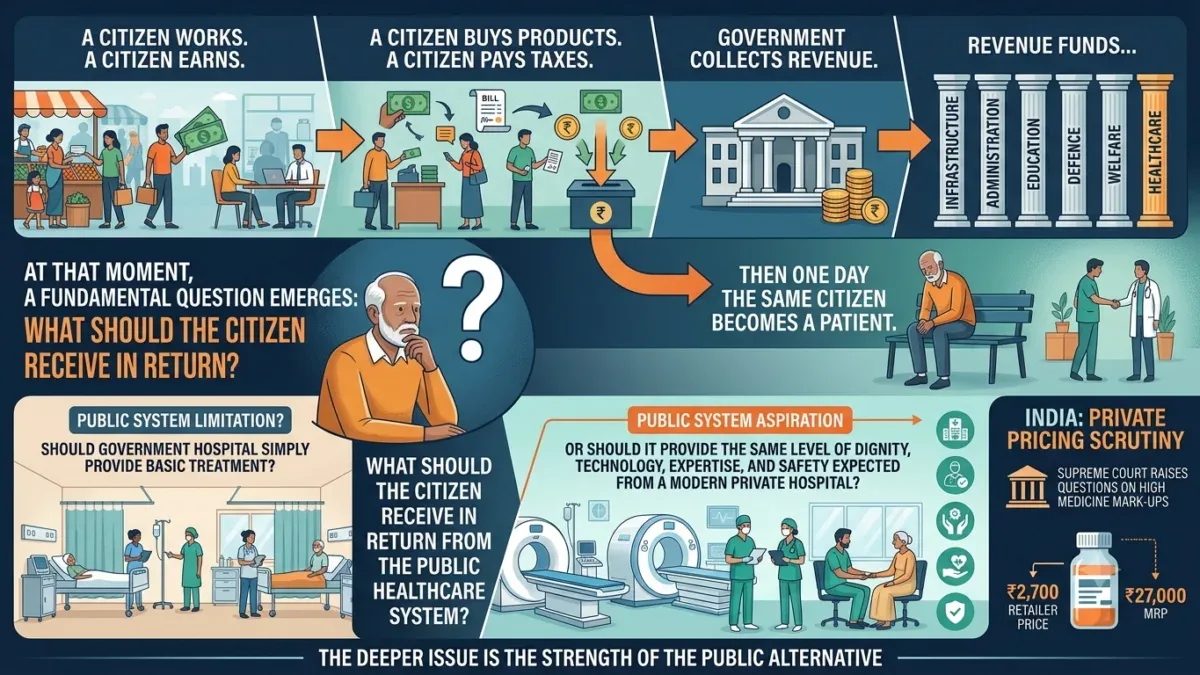
A citizen works.
A citizen earns.
A citizen buys products.
A citizen pays taxes.
Government collects revenue.
That revenue funds infrastructure, administration, education, defence, welfare and healthcare.
Then one day the same citizen becomes a patient.
At that moment, a fundamental question naturally emerges:
What should the citizen receive in return from the public healthcare system?
Should government hospital simply provide basic treatment?
Or should it provide the same level of dignity, technology, expertise and safety that citizens expect from a modern private hospital?
India mein private hospital pricing aur medicine mark-ups par Supreme Court ki recent scrutiny ne is question ko aur important bana diya hai. Reports say the Court questioned very high medicine mark-ups, including a cited cancer drug example where a roughly ₹2,700 retailer price was compared with a ₹27,000 MRP.
But the deeper issue is not only private pricing.
It is the strength of the public alternative.
The Public Hospital Should Not Be a Last Resort
A government hospital ko “last option” samajhna public healthcare ke purpose ko weaken karta hai.
If citizens trust public hospitals, then the system becomes stronger.
Imagine a healthcare system where a patient says:
“Main government hospital ja raha hoon because it is excellent.”
Not:
“Main government hospital ja raha hoon because I cannot afford anything else.”
That difference matters.
Tax Is a Social Contract
Taxation aur public services ke beech ek social relationship exist karta hai.
Citizens do not directly receive a receipt saying:
“Your ₹X tax funded this hospital bed.”
But collectively, public revenue finances government services.
Therefore, taxpayers can reasonably demand:
- quality healthcare
- accessible hospitals
- emergency services
- medicines
- diagnostics
- specialist care
- clean facilities
- transparent systems
- accountability
Public healthcare should be treated as a service obligation, not charity.
India Has Made Progress
India ke official data mein public health spending aur out-of-pocket expenditure trends mein improvement visible hai.
2022-23 National Health Accounts estimates ke according government health expenditure total health expenditure ka 43.7% tha and OOPE 43.4% tak decline hua.
Government has also reported increases in public health spending and efforts to improve healthcare infrastructure.
This progress should be acknowledged.
But progress does not mean the problem is solved.
The Next Question Is Quality
Public spending badh gaya.
Ab question hai:
What did the citizen actually receive?
Did hospital capacity increase?
Did waiting time fall?
Did medicine availability improve?
Did diagnostic machines remain functional?
Did doctor vacancies reduce?
Did patient experience improve?
Did rural healthcare become stronger?
Public expenditure ko outcomes ke saath connect karna zaroori hai.
Government Hospital Ka Success Formula
A government hospital successful tab hai jab patient ko complete treatment journey milti hai.
Not just:
Doctor consultation.
But:
Registration → Consultation → Diagnosis → Medicine → Procedure → Follow-up
Agar patient ko diagnosis ke liye private lab jana pade, medicine private pharmacy se leni pade aur specialist consultation ke liye private hospital jana pade, public system fragmented ho jata hai.
One-Stop Public Healthcare
Future government hospitals ko integrated care centres ki tarah develop kiya ja sakta hai.
Under one campus:
- emergency
- diagnostics
- pharmacy
- surgery
- ICU
- specialist clinics
- rehabilitation
- mental health
- preventive care
available ho.
This reduces patient movement and transaction costs.
Digital Public Healthcare
India digital infrastructure mein global scale achieve kar chuka hai.
Healthcare mein bhi digital systems ka better use ho sakta hai.
Patients ke digital records securely maintain kiye ja sakte hain.
Reports online accessible ho sakti hain.
Appointments digital ho sakti hain.
Medicine stock publicly visible ho sakta hai.
Waiting times dashboard par show ho sakte hain.
Grievances track ho sakti hain.
Technology ka goal flashy app nahi hona chahiye.
Goal hona chahiye:
Less Waiting + Less Confusion + Better Continuity + More Accountability
Private Hospital Ka Role
Private hospitals ko demonise karna bhi wrong approach hoga.
Private sector mein highly skilled doctors, advanced technologies, research, specialised surgery aur modern facilities available ho sakti hain.
Private hospitals system ka important component hain.
But private healthcare should operate within rules that protect patients.
What Should Be Non-Negotiable?
Some principles should apply everywhere.
Transparent Pricing
Patient ko cost samajh aaye.
Informed Consent
Major procedures ke risks and costs explain hon.
Itemised Billing
Patient ko pata ho kis service ka kitna charge hua.
Medicine Transparency
Medicine name, quantity and price visible ho.
Emergency Protection
Emergency patient ko financial bargaining ke bina stabilising care mile.
Grievance System
Patient complaints ka independent resolution mechanism ho.
The Government Must Build the Alternative
Regulation alone cannot solve healthcare affordability.
Suppose government says private hospital cannot charge beyond a certain level.
But public hospital has:
- no specialist
- no ICU bed
- no MRI
- no medicines
- broken equipment
Then patient still has a problem.
Therefore:
Strong regulation + weak public healthcare = incomplete reform.
The real combination should be:
Strong regulation + strong public healthcare.
A New Public Healthcare Benchmark
India national benchmark establish kar sakta hai.
Every district hospital could be evaluated on:
Infrastructure
Doctors
Nurses
Diagnostics
Medicine Availability
Emergency Care
Surgery
Cleanliness
Waiting Time
Patient Satisfaction
Digital Readiness
This data public hona chahiye.
Why Transparency Matters
If citizens can see performance, pressure improves.
Suppose District Hospital A has:
- 15% doctor vacancies
- 60-minute average emergency wait
- frequent medicine shortages
while District Hospital B has:
- 5% vacancies
- 20-minute emergency wait
- reliable medicine supply
Then policymakers can identify what works.
Successful practices can be replicated.
Public Healthcare Should Compete on Trust
Private hospitals often invest heavily in branding.
Government hospitals should invest heavily in trust.
Trust comes from:
Predictability
Cleanliness
Competence
Respect
Transparency
Availability
Results
A patient who trusts the public hospital is more likely to use it early instead of delaying treatment because of fear.
The Cost of Weak Public Healthcare
Weak public healthcare ka cost sirf government budget mein nahi dikhta.
Families lose income.
Patients travel long distances.
Workers miss work.
Children miss school.
Families borrow money.
Assets may be sold.
Debt can continue after treatment.
Therefore, strong public healthcare is also economic policy.
Healthcare and Inequality
When rich people can buy high-quality healthcare while poor families depend on overcrowded public facilities, health inequality increases.
Middle-class families can also become vulnerable during major illness.
One cancer diagnosis can create a financial shock.
This is why universal public systems matter.
The objective is not to make everyone use the same hospital.
The objective is to make sure everyone has access to safe, quality treatment.
Global Perspective
Canada’s public system explicitly aims to provide medically necessary hospital and physician services without patient charges and bases access on need rather than ability to pay.
Australia provides eligible public patients free hospital services while maintaining a private hospital sector.
The UK NHS is taxpayer funded and designed around care free at the point of use.
These systems differ, but they demonstrate an important principle:
Government-funded healthcare can be designed around citizens rather than purely around ability to pay.
India Should Build Its Own Model
India has a unique opportunity.
It can combine:
Public Hospitals
Private Expertise
Digital Infrastructure
Insurance
Strong Regulation
Transparent Data
Community Health
This can create a system suited to India’s scale.
The Supreme Court Moment Should Become Policy Reform
Court observations can create public debate.
But sustainable reform requires policy.
Government should examine:
- medicine mark-ups
- hospital pharmacy practices
- treatment package pricing
- medical consumable charges
- diagnostics
- insurance billing
- public hospital capacity
- hospital transparency
The objective should not be to punish an entire industry.
Objective should be to protect patients.
What Should a Citizen Be Able to Say?
Imagine a future India where a citizen can say:
“My government hospital has a good doctor.”
“My medicines are available.”
“My diagnostic report comes on time.”
“I can see the treatment cost.”
“I can complain if something goes wrong.”
“My emergency will be treated.”
“I don’t need to sell my assets to receive essential care.”
That is the healthcare future India should aim for.
Final Question: What Are We Building?
A country’s healthcare system reflects its priorities.
If public hospitals are neglected while private hospitals become the only trusted option, inequality can deepen.
If private hospitals are unnecessarily restricted, innovation and capacity can suffer.
The answer lies between these extremes.
India needs:
Excellent Public Hospitals
Responsible Private Hospitals
Transparent Pricing
Strong Regulation
Modern Technology
Universal Access
Financial Protection
And above all:
Patient dignity.
The purpose of government healthcare should not be to offer the cheapest possible treatment.
The purpose should be to offer safe, timely, effective and dignified healthcare to every citizen.
Private hospitals can remain part of the solution.
But government hospitals must become strong enough that no Indian family feels that quality healthcare is available only behind a private hospital billing counter.
That is not merely a healthcare reform goal.
It is a social contract.
Frequently asked questions
Questions readers ask.
They should reasonably expect accessible, safe, quality healthcare, functioning infrastructure, medicines, diagnostics, emergency services and accountability.
A strong public system gives citizens a genuine alternative and protects families from financial hardship.
Yes. Private hospitals can contribute infrastructure, technology, specialist care and innovation.
Yes. Patients should be able to understand treatment costs, medicine charges and major billing components.
A mixed system can work when it combines strong public healthcare, responsible private providers, effective regulation, transparent pricing and financial protection.
There is no single reform. India needs simultaneous improvements in public hospitals, regulation, pricing transparency, healthcare workforce, diagnostics, medicines, technology and accountability.